Defenders, defended
You don't miss the Netflix shows; you miss the days when the MCU could be "fine" and get away with it
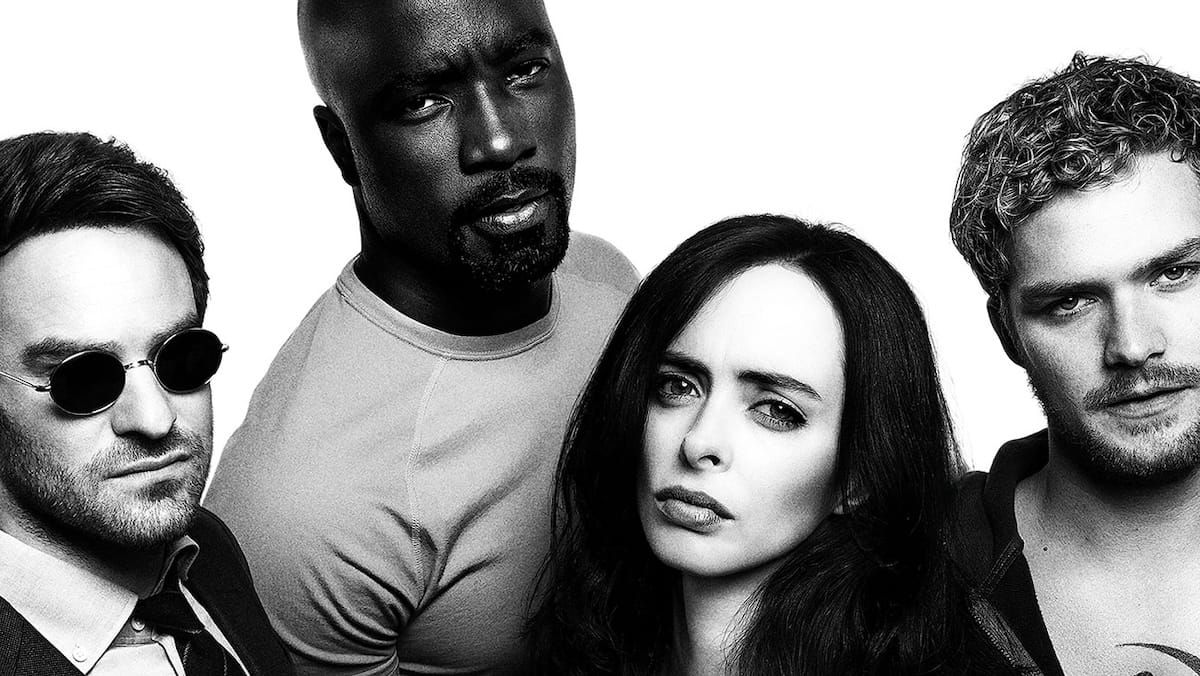
Watching the Daredevil: Born Again season finale this week (on which more in a moment), and spending some time with my former Super Zero running mate Alia Miller, put me in a mind to take a quick trip through The Defenders again — also because I am generally fond of revisiting things that most folks hate and I think we’re unfairly shit on.
To calibrate more precisely: I think the Netflix MCU series*, running from Daredevil season one through Jessica Jones season three and also containing shows featuring Luke Cage, Danny Rand (Iron Fist), and the Punisher (though the latter is not a Defender), were both a smashing success at adapting the larger MCU proper into a street-level TV empire, and were for the most part “pretty good, watchable, entertaining enough,” without ever reliably slipping their own bonds and becoming great.
* There has been a lot of revisionist history about the Netflix shows’ position in the Marvel Cinematic Universe, so let me clarify my take here: these shows were produced and marketed as being part of the MCU and contain frequent references to their being part of the MCU; so no, I don’t think that their status can be retroactively removed and then re-asserted only if and when their characters begin to turn up in (native) Disney+ television shows and Marvel movies. tl;dr: the Marvel Netflix shows, and Agents of Shield and Agent Carter while we’re at it, have always been and will always be part of Marvel’s phases two and three.
The obvious candidate for having slipped those bonds and entered greatness is of course the first season of Jessica Jones, which was — and remains — one of the best pieces of storytelling in the entire MCU. The first season of Daredevil is nearly there as well, its status only burnished in the popular imagination by the new-car-smell of how far off the established MCU model these series were going to go.
But, and it’s a big but, the key to these shows success also perfectly limns the boundaries of their potential. The success of the Netflix Marvel shows was that they were producible and repeatable, both attributes which are a fundamental requirement of television (and one which, strangely, West Coast Marvel Studios needed to learn painfully and in real time when setting up the Disney+ shows in phase four). East Coast Marvel Studios much more quickly and effectively established a factory floor in New York State and began churning out two 13-episode seasons a year, each of which were so on-model that by the time The Defenders turned up, frankly, the new-car smell had evaporated and the sameyness of each successive season of the overall project had long since made itself plain.
The sameyness (or more fairly, established structure) goes like this: each series focuses on one “street-level hero” who has a push-pull relationship with their own heroics. Each season has a Big Bad, usually one whose personal connection to the hero (mother; childhood friend; guru; ex-army buddy) exacerbates the personal conflict. Each season (except The Defenders) is 13 episodes long; the first two episodes are strong, as is a mid-season episode that switches the narrative stakes or steps momentarily outside the format. The last three episodes are usually strong as well, as they draw the season’s arc to a close. Each series has a supporting cast who are given their own secondary storylines, adjacent to the main plot, which allows the actor at the top of the callsheet to have a day off every now and again. Each series makes extensive use of location shooting in New York, which made and make them strikingly different, visually, from the L.A.- and London-based (till that point) movie productions, and the Atlanta greenscreen slop that has festooned the MCU since.
Taken overall, with this common stitching clear by repetition, I’d argue that the highs of the Netflix era are not as high as folks remember (save season 1 of Jessica Jones); and that the lows are nowhere near as low either (even including Iron Fist). The format worked because it worked: because it dependably delivered roughly the same experience over and over and over again, 26 episodes per year, for five years. There were obvious problems — people pick on Finn Jones, but I don’t find Mike Colter to be a particularly adept lead either — but some of the performances (Jon Bernthal, Charlie Cox, Krysten Ritter, David Tennant, Mahershala Ali, and of course, Vincent D’Onofrio) remain all-time MCU watermarks.
This brings me back to The Defenders, which was the television franchise’s attempt to do the Avengers at the street level, bringing the whole gang (except the Punisher) together for a mini-series which, the law of averages perfectly applying, is exactly as good as a meal made of these component dishes could be. I guess, your mileage may vary? I find it charming.
The Defenders follows the first seasons of all four of its heroes, as well as a second season for Daredevil; the latter did a bunch of heavy lifting to get story pieces in place for this team-up, and was showrun by the same writers (Marco Ramirez and Douglas Petrie). Those story pieces include: Elektra; the Hand; and a big fuckin’ hole in the middle of New York City.
Again, your mileage may vary; and again, I find it charming. (I always love a big fuckin’ hole.) I’m agnostic on the Hand as a story device in the comics but I respect their deployment in Daredevil, in Iron Fist, and here; I acknowledge that Sigourney Weaver’s Alexandra completely sucks as a Big Bad**, but I’d also argue that she’s one of those Big Bads (see also: Supreme Leader Snoke) who only exists to move the more interesting character stories into place before stepping offstage.
**But hey, real talk: when was the last time Sigourney Weaver brought out the goods in anything? She’s the femme Harrison Ford at this point. She’s not the get people think she is.
The ultimate YMMV is Elektra, whose storyline in season 2 of Daredevil I really responded to, and whose return here I respond to as well. I just like the Matt/Elektra storyline, and their deeply toxic romance, and I think Elodie Yung is terrific in the part. And since Alexandra has ensorcelled Elektra and is moving her around the game board to fight the heroes, that makes the Elektra/Matt conflict — and its outcome — the more interesting story arc of the season, and Alexandra/The Hand mere plot mechanics.
And the show looks like a million bucks. The first two episodes are directed by S.J. Clarkson, who pushes deep into primary colours and high-key lighting to establish a palette for each of the disparate heroes, which make the night exteriors pop like little on streaming has before (or since). She finds a visual language for each character, starting from Jessica Jones (whose series Clarkson also directed***) and working her way out.
*** The factory farm of the Netflix shows saw some of the best directors working in television these days come through their doors at least once; in addition to S.J. Clarkson, they had Uta Breisewitz (The Pitt, Severance), Jennifer Getzinger (The Penguin, Ahsoka), Kari Skogland (The Falcon and the Winter Soldier), Deborah Chow (The Mandalorian), Steph Green (Watchmen), and dozens of others. As this list might suggest, their gender parity in the director’s chair was also industry-leading.
Arguably, Clarkson finds a slicker, more engaging visual style for Iron Fist than his eponymous series ever did… which doesn’t solve the Finn Jones problem, though Jones does improve measurably once the four Defenders are together in the Chinese restaurant, and Danny’s less the aggrieved hero of his own deluded fantasy and more the wanky kid brother that everyone barely tolerates but who occasionally gets a good dig in.
And the unacknowledged strength of the Netflix shows remains their secondary casts, and I love how much that strength is on full display here: Elden Henson, Carrie-Anne Moss, Simone Missick, Jessica Hennick, Eka Darville, Rosario Dawson, and even Rachael Taylor all pop in The Defenders, in some cases more so than they do in their source series.
This brings me back to the unholy mess that has been Daredevil: Born Again, whose creative and production travails are probably worth a book or two (that Disney will never allow to be published), and which I’m not researched enough to outline here. I’ll respond as a viewer instead: Born Again season 1 (or Daredevil season 4, if you’re nasty) was an atrocious misfire, the worst thing Marvel has done that didn’t include the words “Secret” or “Invasion” in its title. It was a willy-nilly failure to commit to its own bit, walking back every creative and narrative decision it made in real-time, like a slow-motion Rise of Skywalker.
Season 2 (or 5, whatever) starts in much the same vein, though I must admit it picks up markedly by episodes 6, 7, and 8. (There’s also a mid-season episode featuring extended flashbacks to the pre-Netflix days that is quite good; amusingly, Disney+ somehow managed to skip it completely while I was watching, so it was only when I asked myself, “wait a minute, wasn’t Elden Henson supposed to be in this season?” that I figured it out and went back, which means I watched that episode last.)
The series (like everything else in television) suffers by proximity to Andor, especially given that Born Again season 2 directly and clearly invokes both ICE’s extrajudicial occupations of American cities and (much more clumsily) the January 6 insurrection, but — unlike Andor — Born Again has neither the creative will nor the political imagination to actually use those image systems as anything other than table setting. (Shades of Christopher Nolan’s pillaging of Occupy Wall Street imagery as set dressing for The Dark Knight Rises.) Arguably, the only meaningful swing the series takes — if accidentally — is to recall Donald Trump’s long-ago promise that he could murder a man on 5th avenue and still be adored by his acolytes. By Born Again‘s finale, Wilson Fisk is a full-on Trump analog, and comes close to testing Trump’s assertion, brute-forcing his way through a throng of (red-hatted!!) protestors and somehow still ending up with a sweetheart deal that sees him safely out of the way by season’s end, but not dead or in jail. The poke at the sheer ballslessness of America’s moral certitude is thin, but noted.
Obviously, my Defenders craving was stoked by seeing Jessica Jones (and later, Luke Cage) back in the game, though as is par for the course on this show, Born Again doesn’t really give Jess anything to do besides “exist.” Much of the series’ shortcomings are the direct inverse of the Netflix series’ unacknowledged strength, as outlined above: the new show almost completely failed to established its new supporting coterie as a) interesting characters in their own right and b) secondary storytelling lanes that support the season’s main thrust. Born Again is only somewhat figuring out how to do this by the end of season 2.
Partly, this is because half of the supporting characters are either killed or shuffled offscreen. Of those left, I admit that by series’ end, I was quite taken with BB Urich (Genneya Walton), lil’ White Tiger (Camila Rodriguez), Bullseye (Wilson Bethel, a role that never clicked for me in Daredevil season 3, but he’s growing on me), and even the guy with the most scream-inducingly hilarious name in the history of television: British mob enforcer BUCK CASHMAN.
Born Again is heading fully into its Defenders heritage, too, with Finn Jones and Mike Colter (and, maybe, Elodie Yung?) joining Krysten Ritter and Charlie Cox in season 3, even as Matt’s storyline looks ready to mine one of the better comic runs of the 21st century. Will there still be an MCU by the time it’s released, or will all this have been Secret Warsed out of existence (again)? Who knows. But the agonizing pivot by Disney to making TV that is actually TV — producible and repeatable, rather than cheaply-produced movies cut into six pieces — gives me hope that the stakes aren’t even high enough that the show can’t pivot where it needs to. That’s the crack that the best Marvel TV, including the Netflix shows, always fit nicely within: the bigwigs aren’t looking, so let’s just do our own thing.
Hey guys! What else is going on?
You guys good? Good spring so far? How’s life?
- I’ve been thinking about The Natural a lot lately as we all watch the fall of America, even though I’ve neither seen the film nor read the book in several decades. It might be time to revisit both. Here’s a great piece by Olivia Rutigliano. (Bright Wall / Dark Room)
- There was just so much good Star Wars stuff last week, I won’t share all of it, but I found this chat between Chris Ryan and Sean Fennessey about the franchise in general and Andor specifically utterly delightful. (The Big Picture podcast)
- The Wachowskis' Speed Racer is on 4K disc as of next week, so I was watching this. You should too: