The chaos of image
When is a trek not a Star Trek?

How do you imagine the future? Of late, one would be forgiven for extrapolating the darkness of the moment’s horror-show into a spin-the-dial, who-the-fuck-knows apocalyptic nightmare. That, I suppose, is part of the fascists’ project as well: once they’ve bludgeoned our present so mercilessly that we cannot even imagine a better “what comes next,” they’ve won.
The project of science fiction, on the other hand, has largely been about imagining the future; extrapolating some piece of science (hence: the name) outward and pondering how our story (hence: the name) might work under those changed conditions.
This is not to suggest that science fiction inherently imagines positivity. “Technology is dangerous and humans are dumb” is both a longstanding sub-genre of science fiction and also one of sci-fi’s tropes that living humans right now are working extra, extra, super hard to prove, for reasons unknown.
But it doesn’t have to go that way. About sixty years ago, mid space-race, a bloke imagined a future where we just kept racing to space, kept doing it for three hundred years, kept that project of earnest outward projection going for so long that it washed away all the trivial tribal quibbles here on Old Planet Earth, replaced them with Tribbles, and Tellarites, and Klingons and Gorns, and all manner of who-the-fuck-knows threats that were out there, but not down here, because — as anyone who has spent any amount of time pondering why we’ve yet to be visited by aliens on this stupid little dirtball called home eventually realizes — one does not generally become adept at solving the monumental challenge of spaceflight while still doing shenanigans about oil and borders and race and gender and sex and love and all the other workaday nonsense that makes us still apes, and not Men.
That’s a gloss — Gene Roddenberry as a person, and Star Trek as a format, were obviously significantly more backwards and self-contradictory than everything I’ve skated over in the previous paragraph — but it’s a gloss I like. It gets to the heart of the format, you see, which basically goes like this: to get to space we had to solve our shit; and our conflicts, therefore, are found out there, externally, not in here, amongst ourselves. It’s a dramatic tenet as old as Homer (wait till you see The Odyssey in IMAX 70mm this summer, drama nerds!): the monsters externalize the conflict within the hero. Throw in some swashbuckling Hornblower and a ray-gun or two, and you’ve got Star Trek.
That format, that science fiction project, held more or less until Roddenberry’s death in 1991, at which point every downstream writer declared “fah, no” re: the whole conflict thing and started adapting the format to fit their purpose. I think what gets interesting is what elements of the format they chose to adapt vs. outright throw away.
The “no conflict between characters” thing was the first man brought to the guillotine after Roddenberry died, but that creative decision also led to what is probably — what will probably remain — the richest adaptation of Star Trek in the franchise’s history, which is Rick Berman and Michael Piller’s first Roddenberryless TV series, Deep Space Nine.
This is because DS9 actively and recursively meditates on some of the questions inherent to the format that I glossed over in the gloss above; it drags the inherent colonialism, the queasy militarism, even the subtextual supremacy, of the original Star Trek and its sequel, Star Trek: The Next Generation, into the light and really works ’em over. It imagines a future where collaboration and community-building are fundamental to any effort to healing the wounds of conflict, however that conflict may fall; and where “flying off to the next planet” is never an option, so all of the building must happen here, now, over years and eventually decades. tl;dr, it’s the best.
Other adaptations followed. Berman and his peers kept the engine chugging through 2005; our old pal J.J. Abrams and his cronies took over after that and (sans Abrams) still run the show today.
How do you imagine the future?
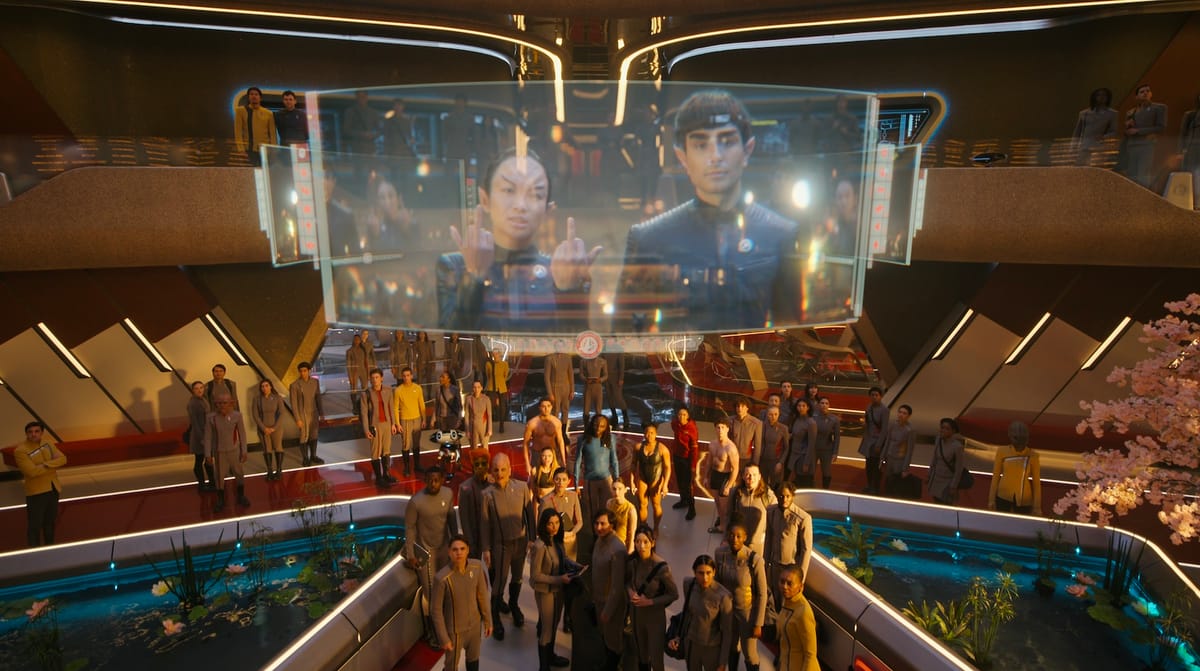
The producers of modern Star Trek — “NuTrek,” as it is colloquially called — don’t imagine it. They don’t even, it seems, imagine a future where Star Trek is a viable enough entertainment franchise to justify its own existence.
They imagine that Star Trek’s vision of the future — which is both the series’ premise and its format, mind — is so alienating and unconvincing to a modern audience that no normal money-spending human (i.e., not a “nerd,” in spite of “nerd culture” having fully overtaken the entirety of mainstream popular culture) would ever enjoy it. The project, since 2009, seems to have been to make Star Trek first and foremost something that is Relatable with a capital R; a “they’re just like me!” solve for a problem that never existed.
So, they imagine this:

Welcome to Starfleet Academy.
To be continued…
Next week, we’ll dive into how a series can pay endless lip service to the “ideals of Star Trek” while still presenting a worldview that holds that the future will be violent, nihilistic, and generally not much better than the shit we’re living in now.
Home Alone 3
I had an idea a long time ago, I don’t know, maybe I tweeted it. I’m overall not a fan of the “skip certain sequels and do a true sequel” approach to franchising, but the idea basically was: you do Home Alone 3, ignoring all the non-Culkin movies. It’s a legacy sequel. Kevin is an adult now. The poster is a single of Macaulay Culkin looking mischievous, nearly winking at the camera, now a 40-something-year-old man. He has a sledgehammer over one shoulder, and the caption is “Kevin McCallister has spent his last Christmas alone.”
Behind Kevin is a jail. Perhaps Larry and Marv are climbing around the edges of the jail like in the Home Alone 2 poster, cuz they’re in this. The most important thing about the sequel is who’s in the jail: it’s Kevin’s mom, who got sent away for reckless child endangerment when Kevin was a teenager and. has been patiently serving out her 30-year sentence since.
The movie’s about Kevin — with the help of the Wet Sticky Bandits — breaking Mom out of jail. Because Kevin’s done spending Christmas without his mom.
Anyway. This fantasy was never gonna happen for a trillion reasons and now it won’t happen for exactly one, which is that the most important person in that cast has died. She was great, wasn’t she?
Further reading
I finally read Gretchen Felker-Martin’s Manhunt last week. It’s a strong recommend from me, albeit one that only applies to people with unusually strong stomachs and a high tolerance for queer pain. The pokes at the intellectual and moral laziness of the TERFs — the Head TERF in particular — are a hoot, and I screamed out loud when the U.S.S. Galbraith made its appearance. But transness aside (or perhaps not?) the book also does a chillingly strong job of sketching out that moment, the one where it really is going to come down to who’s willing to kill more of the other side first; and how that might feel, no matter who you think you are now.
Elsewhere in the world, a few writing samples from your old pal, in case you want to hire me to write literally any kind of copy:
- Slippery Slope: Disinformation, Cybersecurity, and Free Speech
- Move Fast, Break Everything: The Risk Landscape of A.I.
I’m as surprised as you are that these are things I’m paid to do!
And if you haven’t read Cory Doctorow’s longread about A.I. and reverse centaurs, please do. It’s great.
Celebrate the small things
I got a rejection letter last week from a publishing house and it was really lovely. Kind and encouraging, while still being a “no.” And since the house in question does all its business on paper, I got it in the mail! It made me feel more on-track than a rejection rationally ought to have.
I shot a little time-lapse during the blizzard, just to do it, and posted it on my TikTok page a couple hours later; it’s not much of anything in particular but it was a nice thing to do. This, in turn, got me started on a different experimental video I’ve been noodling for a while, and will shoot in February.
I went to a sequel movie all by myself — itself, not unusual — and had such a great time trying to work out the rules and weights of its story universe, having not seen the movie’s prior entries. I found the whole thing uncommonly rewarding.
I wrote a 6-page short script for fun and it came out perfectly, with “perfectly” here meaning “exactly, exactly fulfilling all my creative intentions.” It probably needs a bit of work otherwise, but I want to make that movie, which is a thing I haven’t done in a long time. I wonder how I’ll do it.
I added a small bookcase to my bedroom just for ratty old paperbacks, and it’s crazy how much cozier the whole space feels now.
Over on Letterboxd, the movies are good.

All this to say, I’m hanging on by my fingernails over here. I’m sure you are too. But we are hanging on.
Stay warm everybody. Fuck the fascists, and fuck the acquiescent.